Hard/Graft : towards community orchards
An art project by Seoidín O’Sullivan in association with Common Ground – as part of studio 468’s CITIZEN ARTIST award 2017.
HARD/GRAFT’S research continues Seoidín’s interest on issues of sustainable cities, land access, food access and spaces of 'commoning'. Through this project she will playfully tie a planting (grafting) project to an unearthing of questions of labour (graft). She is particularly interested in ideas of reproduction and the invisible/immaterial labour of people who care for others and mothers/ minders.
The graft
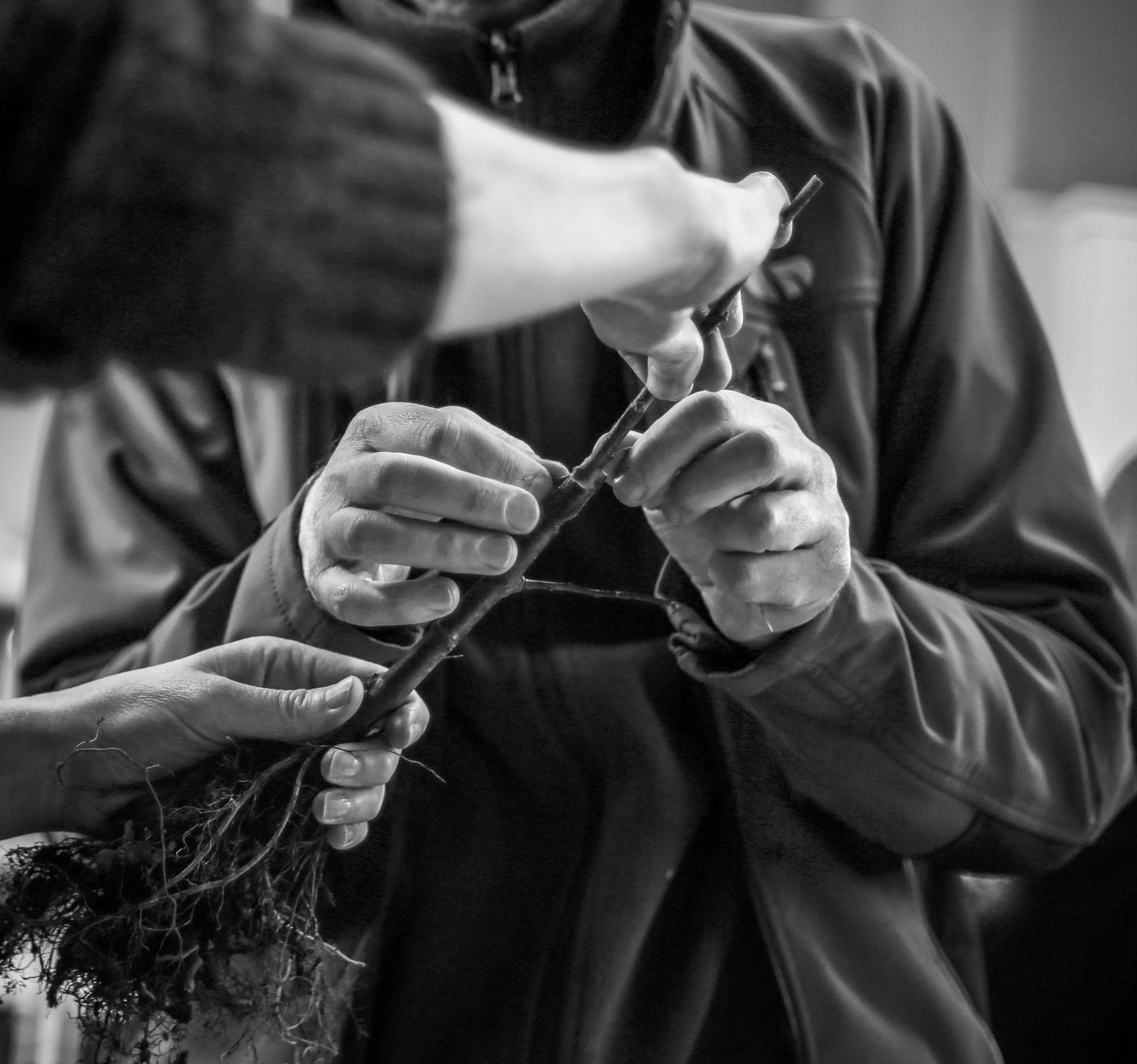
Hard/Graft: towards community orchards begins with fruit tree grafting.
Deleuze and Guattari in ‘A Thousand Plateaus’ site the rhizome as having a potential for disruption. "A rhizome has no beginning or end; it is always in the middle, between things, intermezzo. The tree is filiation, but the rhizome is alliance..." (Deleuze and Guattari, 1988: 25)
The Graft is the trees rhizome. By cutting branches (scion) we are able to quite quickly graft and reproduce many trees. By collectively grafting, planting and meeting we create solidarity and alliance.
Planting orchards
Working with community groups in St Andrews community centre heritage apple trees from UCD have been collectively grafted towards future orchards for Dublin 8. These final orchards will include the grafted trees and other mixed fruit and nut trees. The project will negotiate with community and stakeholders on where these orchards will be planted.
Community Orchards are a commons, they are green spaces in the city where communities are able to access free food and be connected with a seasonal cycle. They create spaces where people can relax and meet and provide a place for pollinators.
Feminist Reading Group
While in studio 468 Seoidín has initiated a reading group with a group of feminist mothers. Collectively they are looking at ‘Women's Labour’ and unpacking feminist ideas and biases toward housework and the home including ‘Can the home be seen and recognised as a place with political potential?’ Through regular meetings they are building up an archive of reading material and creating a solidarity and visibility to women and their labour. This investigation is lead through texts that include Bell Hooks ‘Home Place’ and Silvia Federici’s ‘Wages for Housework’.
Tree Politics
HARD/GRAFT also looks to the politics of trees. Where are trees found in Dublin City? Are they linked to ideas of privilege?